

In the past, a product's success often depended on three factors: appearance, functionality, and price.
However, in recent years, the global mindset around product development has been shifting. When brands prepare to launch a new product, besides asking "Will consumers like it?", they also ask a few questions that rarely came up in the past:
- Is this material recyclable?
- Can the packaging be reduced even further?
- Can it be repaired if it breaks?
- Where will it end up after ten years of use?
Behind all these questions lies the exact same keyword—ESG.
ESG is no longer just a term in corporate sustainability reports; it is becoming a key factor that influences product design, material selection, manufacturing processes, and brand strategy. For designers, this means the scope of thinking in product design has expanded from "designing a product" to "designing the entire life cycle of a product."
Why is ESG starting to influence product design?
ESG stands for Environmental, Social, and Governance.
Many people believe ESG is just about environmental protection, but in fact, it is more like a framework for re-evaluating how a business operates. For product design, the most direct impact comes from Environmental factors, including issues such as material sources, energy consumption, packaging, carbon emissions, and product recycling.
Social and Governance factors are gradually extending to aspects such as product safety, supply chain transparency, raw material origins, and regulatory compliance. In other words, the standard for whether a product is "well-designed" is no longer based solely on aesthetics and functionality, but has begun to include its overall impact on the environment and society.
Global brands are changing the way products are designed.
Observing global brands in recent years, a common trend can be seen:
Design hasn't become more complex; instead, it has begun to become more restrained.
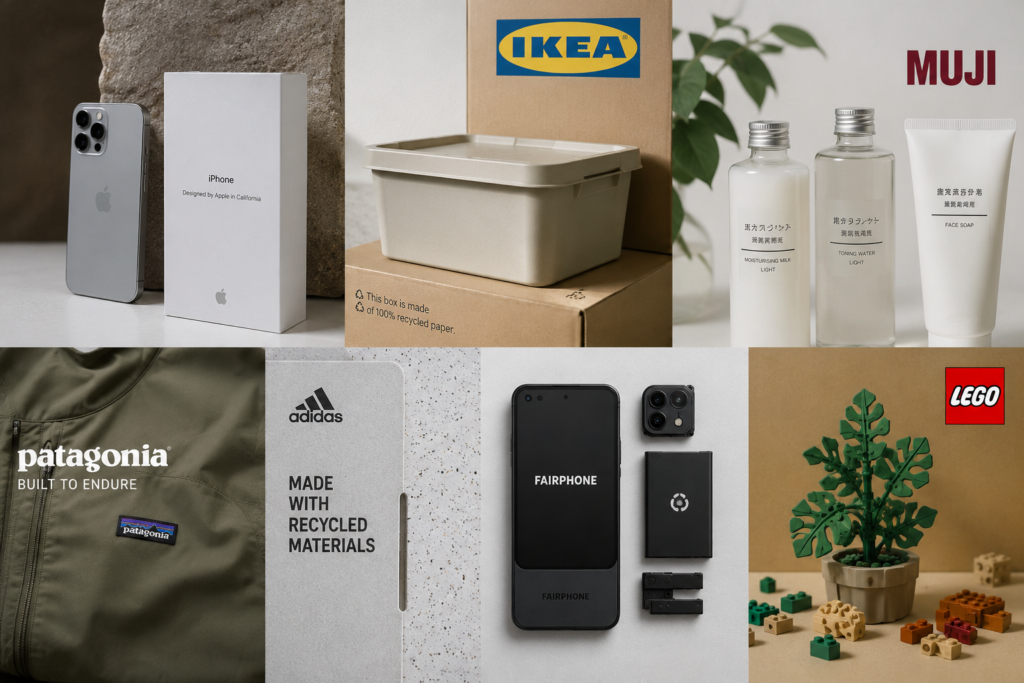
Apple continues to reduce plastic usage in its packaging and is moving toward 100% fiber-based packaging; IKEA has integrated circular design[1] principles into its product development, aiming to make products easier to reuse, repair, and recycle; Patagonia, through its Worn Wear [2] program, encourages consumers to repair their garments and extend product lifespan rather than frequently buying new items.
What these brands have in common is not simply design style, but that they have begun incorporating the "product life cycle" into their design decisions.
1. Materials: No longer just about cost and performance
In the past, material selection usually revolved around three things: cost, strength, and appearance.
Today, more and more brands are adding a fourth consideration: Is this material more sustainable?
In recent years, it has become increasingly common in product design:
- PCR (Post-Consumer Recycled) plastic
- FSC-certified wood
- Recycled aluminum
- Bio-based Materials
- Ocean-bound recycled plastic
It is worth noting that ESG does not require companies to completely abandon traditional materials; rather, it encourages prioritizing materials with a lower environmental impact, provided product requirements are met, and increasing the possibility of material circularity. For brands, materials are no longer just an engineering choice, but have become part of the brand's value.
2. Packaging Design: Pursuing "Less"
Once, elaborate packaging was synonymous with luxury.
Today, great packaging increasingly means using the minimum amount of material to achieve maximum value.
In recent years, many brands have continually optimized packaging sizes—not only to reduce material usage, but also to improve transport efficiency. When a package is reduced by 10%, it represents more than just savings on packaging materials; it can also mean fitting more products into a single shipping container, thereby lowering logistics costs and transport carbon emissions.
Therefore, packaging design today is no longer just graphic design, but an interdisciplinary task combining structural design, logistics management, and sustainable thinking.
3. Products are starting to emphasize "repairability"
In the past, many products adopted highly integrated designs. If a single component failed, it often required replacing the entire product.
However, in recent years, "Design for Repair" has gradually become a new direction in design.
Dutch brand Fairphone [3] is a prime example. It adopts a modular design, allowing users to independently replace components such as the screen, battery, and camera modules—aiming to extend product lifespan and reduce electronic waste.
In addition to brand-led initiatives, the EU has also established "Right-to-Repair"[4] regulations for certain product categories. Relevant policies aim to enhance product repairability and reduce resource waste. This means future design is not just about how to assemble, but also about how to disassemble and repair.
4. Moving from "recyclable" to "easily recyclable"
Many people believe that as long as a product is recyclable, it is enough. In fact, while many products are labeled as recyclable, they are not necessarily easy to recycle.
The reason is that if a product simultaneously uses multiple materials—such as plastics, metals, rubber, and adhesives—even if the individual materials are recyclable, the difficulty of disassembly can significantly lower recycling efficiency. Consequently, product design in recent years has begun emphasizing: mono-materials, modular structures, design for disassembly, and standardized parts.
In the ESG era, design is not just about how to assemble a product, but also about whether it can be efficiently recycled and re-enter the loop after its end-of-life.

📌 Next keyword: Digital Product Passport (DPP)
In addition to shifts in materials and design approaches, another major trend worth noting is the Digital Product Passport (DPP)[5].
The European Union is pushing forward relevant frameworks to give products a traceable digital identity—recording information such as material composition, raw material sources, repair information, part replacement methods, recycling guidelines, and carbon footprints.
In the future, this information will not only serve as a reference for consumers, but will also benefit repair services, recyclers, and supply chain management. While the implementation timelines for different product categories are still progressing, it is expected that product information transparency will gradually become the new industry standard.
ESG does not restrict design; it elevates its value.
Some worry that ESG will stifle creativity in design. In reality, truly great design never stops innovating because of constraints—it finds better solutions under new conditions.
When design begins to extend from the product itself to its entire lifecycle, sustainability is no longer just a matter of corporate responsibility, but an integral part of product design. It forces us to think about how, five or ten years from now, a product can still become a new resource once again.
——
[1] Circular Design:https://circular-taiwan.org/circular-design-guide/
[2] Worn Wear:https://circular-taiwan.org/case/patagonia/
[3] Fairphone:https://zh.wikipedia.org/zh-tw/Fairphone
[4] Right-to-Repair:https://circular-taiwan.org/2024/03/14/right-for-repair-in-european/
[5] Digital Product Passport:https://www.reccessary.com/zh-tw/insight/eu-digital-product-passport
——
The content is organized from online sources.
#ESG #Sustainability