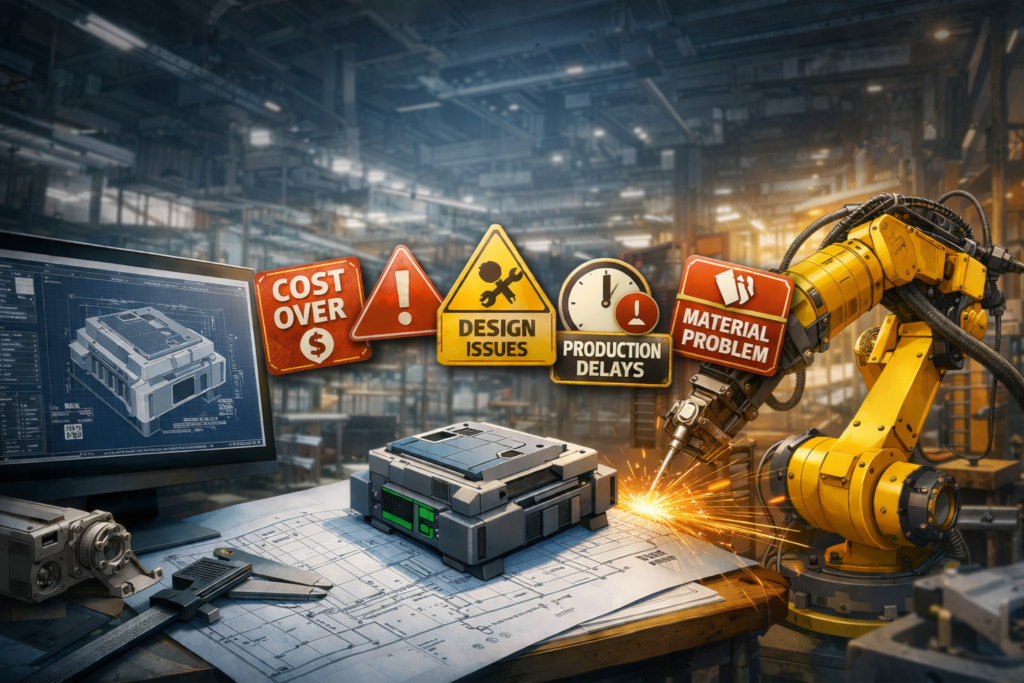
Many brands have a very straightforward question during product development:
"As long as we have CAD design drawings, can we go straight into mass production?"
On the surface, the answer seems to be yes. After all, CAD drawings already include dimensions, structure, and form—it looks like everything is there. But in practice, many product issues actually begin when CAD drawings are taken straight into production.
This article outlines the five key issues brands most commonly encounter, helping you determine:
👉 Whether your CAD design drawings are truly "ready for mass production."
Problem 1 | A CAD design does not equal a "manufacturable design"
This is the most common misunderstanding.
A CAD design represents "design intent," but it doesn't necessarily mean the design is suitable to be produced using real-world manufacturing processes.
Common situations include:
- The structure works in software, but is difficult to manufacture in reality.
- Too many curved surfaces and chamfers drive mold costs too high.
- Tolerances are not designed with mass-production variation in mind.
👉 This is also why "good-looking designs" so often run into problems during mass production.
Problem 2 | The design stage does not take actual manufacturing processes into account
Different manufacturing processes place completely different demands on design.
For example, injection molding, CNC machining, die casting, and ceramic firing each come with their own constraints and cost structures.
If the manufacturing process isn't defined during the CAD design stage, factories are forced to make it work afterward—often resulting in either soaring costs or unstable quality.
👉 Design for Manufacturability (DFM) is exactly what plays a critical role at this stage.
Problem 3 | Material selection focuses only on appearance, not the supply chain
In many CAD designs, material choices come from the visual or concept stage:
- They look premium.
- The colors are appealing.
- The texture matches the brand's vision.
But only during mass production does it become clear that:
- The material supply is unstable.
- Minimum order quantities are too high.
- The unit cost doesn't match the product's market positioning.
👉 At this point, going back to revise the design often ends up costing even more.
Problem 4 | Missing an intermediate checkpoint between design and mass production
Between design and mass production, there should actually be several key checkpoints, such as:
- Whether the structure can be assembled and disassembled.
- Whether the mold design is feasible.
- Whether it can pass basic quality control processes.
👉 If these points aren't reviewed during the design stage, the problems will be pushed back and only surface during prototyping—or even mass production.
Problem 5 | Only thinking about "whether it's worth making" after the design is finished
This is the most regrettable—and also the most expensive—kind of mistake. Many brands end up in a situation where:
- Finish the design first.
- Then start evaluating costs and the market.
- Only to find in the end that it doesn't meet expectations.
👉 If design is treated as a "decision-making tool" early on, many risks can actually be identified much sooner.
So what kind of CAD design drawings are actually suitable for mass production?
They usually share several key characteristics:
- The manufacturing process has already been considered during design.
- The structure and dimensions follow mass-production logic.
- Material choices are supported by the supply chain.
- The design can still be adjusted based on needs, rather than being locked in all at once.
Conclusion | CAD drawings are not the end point, but a decision point
CAD design drawings are important, but they shouldn't be the starting point for placing a mass production order.
A better approach is to treat CAD designs as:
👉 A basis for helping you decide whether a product is actually worth making.
When design can answer "can it be made," "is it worth making," and "should we continue" at an early stage, product development no longer relies on pushing forward based purely on intuition.
—
The content is organized from online sources.
#productdevelopment #productdesign #developmentrisk #designprocess #caddesign