
What is PI (Physical Internet) ?
PI (Physical Internet) is an innovative model for logistics and supply chain operations, inspired by the principles of how the Internet functions. It applies the concepts of data networks to physical logistics and the movement of goods, aiming to build a global logistics network that is standardized, resource-sharing, highly efficient, and sustainable.
Core Concepts of PI
- Standardized and Sharing:PI advocates for the establishment of globally standardized logistics resources (such as containers, warehouses, and transportation vehicles), and enhances resource utilization through a sharing mechanism to reduce idle capacity and waste.
- Digitization and Intelligence:By integrating technologies such as the Internet of Things (IoT), Artificial Intelligence (AI), and blockchain, PI enables real-time tracking, coordination, and optimization of goods, transportation capacity, and warehousing.
- Physical-Digital Integration:Just as the internet enables the free flow of information, PI allows physical goods to move freely within a global logistics network. Businesses can instantly access idle resources, operating in a way similar to the sharing economy models of Uber and Airbnb.
- Sustainability:Improve transportation efficiency and reduce carbon emissions, promoting green logistics and the development of smart cities.
Traditional Logistics x PI (Physical Internet)
| Aspect | Traditional Logistics | PI (Physical Internet) |
|---|---|---|
| Companies build their own warehouses and transportation resources; resources are scattered and have high idle rates | Shared warehouses, trucks, and other logistics resources; maximize resource utilization through standardization and certification, similar to the Airbnb and Uber models | |
| Information silos, lack of real-time and transparent data sharing | Digitalized, standardized, real-time interconnected information; enhanced transparency and trust with blockchain and IoT technologies | |
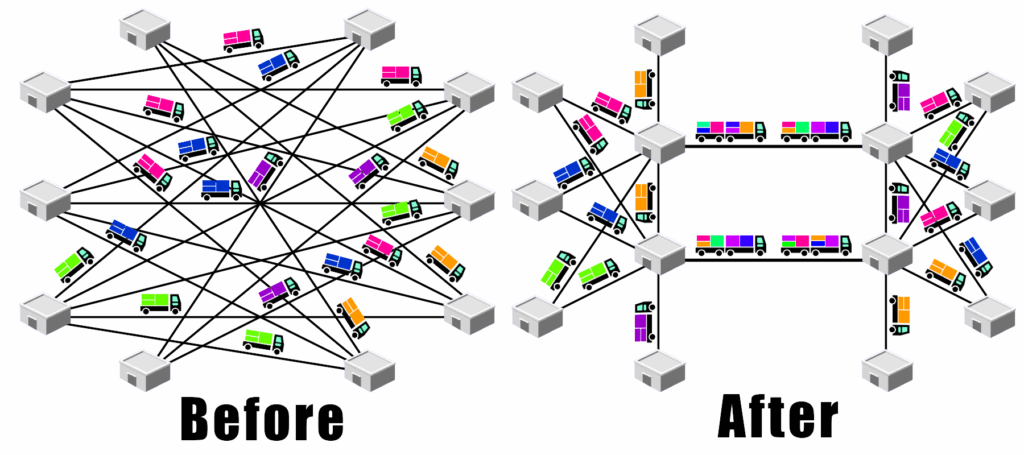
| Overlapping routes, high empty load rates (e.g., trucks are empty 20% of the time) | Intelligent dispatch and joint distribution; higher load rates, cost savings, and reduced carbon emissions | |
| Lack of unified standards, diverse logistics equipment and processes | Establishment of globally standardized logistics containers, pallets, warehouses, and transport protocols to enable interoperability | |
| Companies operate independently with limited cooperation | Multi-level, multi-company, and multi-national interconnection, forming an open and collaborative logistics network | |
| High carbon emissions, severe resource waste | Shared and intelligent systems reduce transportation frequency and empty loads, promoting green logistics and sustainable supply chains |
How PI Improves Logistics Efficiency and Reduces Costs
- Maximize shared logistics resources
PI advocates for the standardization and sharing of logistics resources (such as transportation vehicles, warehouses, and containers) to avoid idle resources and redundant infrastructure. Studies show that traditional trucks are empty about 20% of the time, and overlapping transportation routes cause resource waste. Through sharing and collaborative scheduling, PI improves load rates and reduces empty runs, thereby saving fuel and labor costs. - Smart route planning and real-time monitoring
By integrating the Internet of Things (IoT), GPS positioning, and big data analytics, PI enables real-time tracking of goods and vehicles. It optimizes transportation routes based on real-time data such as traffic conditions and weather, reducing travel time and fuel consumption. This not only speeds up delivery but also lowers additional costs caused by delays and poor road conditions. - Digitalization and automation operations
PI promotes the automation upgrade of warehouses and distribution centers, such as intelligent sorting, unmanned warehouses, and automated loading and unloading, enhancing operational efficiency and reducing labor costs. At the same time, data sharing and intelligent scheduling systems make logistics processes more transparent and collaboration smoother, reducing error rates and inventory backlog. - Supply chain collaboration and economies of scale
PI promotes cross-company and cross-regional logistics collaboration, integrating upstream and downstream supply chain resources to achieve scaled organization and specialized services, thereby reducing redundant transportation and idle facilities. For example, through a satellite warehousing strategy, brands can establish small warehouses in multiple locations, shortening delivery distances and times, and lowering last-mile delivery costs. - Sustainable development and cost savings go hand in hand
PI emphasizes green logistics by improving transportation efficiency and resource utilization, reducing carbon emissions and environmental impact. This aligns with global sustainability trends and brings long-term cost savings.
Is PI Already Implemented Worldwide?
📌 PI has gradually moved from the conceptual stage to practical applications and pilot implementations, with experiments and projects underway in various locations around the world.
- China
In May 2025, the world's first "Physical Internet Shared Space" officially opened in Shanghai Hongqiao International Central Business District, marking a major breakthrough in the physical application of PI. This center brings together enterprises, academic institutions, and government agencies to promote an open, standardized, and interoperable logistics network. - Europe
Since 2010, the European Union has actively promoted PI, incorporating it as a core strategy for logistics innovation. Several European countries (such as Austria, France, Germany, and the Netherlands) have launched multiple PI pilot projects and plan to establish a complete Physical Internet system by 2030. - Japan and The United States
Japan established the "Japan Physical Internet Center (JPIC)" in 2022, focusing on standardized and sustainable logistics. In the United States, PI concepts are promoted through academic and industry collaborations, with multiple demonstration projects currently underway.
Future Outlook
- Widespread adoption still requires time
Although PI has entered practical application stages in China, Europe, and other regions, achieving full global logistics integration with PI is expected to take another 10 to 15 years. The goal is to realize a global automated and interconnected logistics network by 2040. - Development Trends
With policy support, technological advancements, and industry collaboration, the implementation of PI will continue to expand and is expected to become the mainstream model for logistics and supply chain management in the future.
📌 PI (Physical Internet) has already begun implementation in certain regions, with multiple concrete pilot projects and applications. Although it is not yet fully widespread, its standardized, shared, and intelligent logistics model is gradually moving from theory to reality and is expected to become a key trend in global logistics development in the future.
—
The content is organized from online sources.
#PI #Physical Internet #AI #IoT #Logistics