Imagine this: in the past, if you wanted to enjoy a French fine dining meal, you had to go to the market yourself, pick out ingredients, study recipes, practice your knife skills, and then spend hours sweating away in the kitchen (this is like the traditional design process—learning software, drawing lines, adjusting colors).
But now, you walk into a top-tier restaurant and simply tell the chef: "I want a vibe that feels like a romantic, light Parisian afternoon." The chef then creates and serves a perfect dish based on your vibe.
That's Vibe Design.
I. What Is Vibe Design?
Simply put, Vibe Design is a new design approach where you "just use your words." It no longer requires you to master complex tools like Photoshop or Figma; instead, you communicate with AI and describe the feeling you want.
- Traditional design: Focuses on details like "how thick should this line be" and "where should this button be placed."
- Vibe Design: Focuses on questions like "Should this product feel professional or playful?" and "Should it resemble a luxury watch or street art?"
II. Why Is It So Popular in 2026?
With the explosive growth of AI technologies (such as Google Stitch), AI has now learned virtually every design style in the world. It no longer needs you to teach it how to draw—it needs your "taste" and your "direction."
- From Beginner to Master: As long as you can communicate, you can create professional-level interfaces (UI) or posters.
- Blazing Fast: What used to take two days to revise a style now only requires you to say, "Make it feel more futuristic," and a new version appears in three seconds.
- No More Generic Results: Although it's AI-generated, because you define the "vibe," the outcome reflects your unique aesthetic.
III. From "Drawing by Hand" to "Designing by Voice": The Core Spirit of Vibe Design
The core principle of Vibe Design is: "Focus on the feeling and the goal, and skip the tedious tool operations." Traditional UI design typically goes through a long process—from sketches and wireframes to high-fidelity mockups. In contrast, Vibe Design advocates "going straight to the final result," generating usable, high-fidelity interfaces directly.
Its key characteristics are mainly reflected in the following three dimensions:
- Natural Language–Driven: Users no longer need to master professional tools like Figma or Adobe. Instead, they can simply describe the desired interface in natural language. For example, saying "I want an interface like Stripe—minimalist and inspiring confidence for Gen Z" allows AI to translate these emotional cues into a visual design.
- Streamlined Workflow: AI skips the gray areas in between, reducing the distance between creative ideas and final output to just a few conversations.
- Shift in the Designer's Role: A designer's value is no longer defined by technical drawing skills, but by "taste" and "direction." Professionals are evolving into "curators," refining AI-generated outputs to ensure the design aligns with brand depth and identity.
IV. An Industry Game-Changer: The Full Evolution of Google Stitch
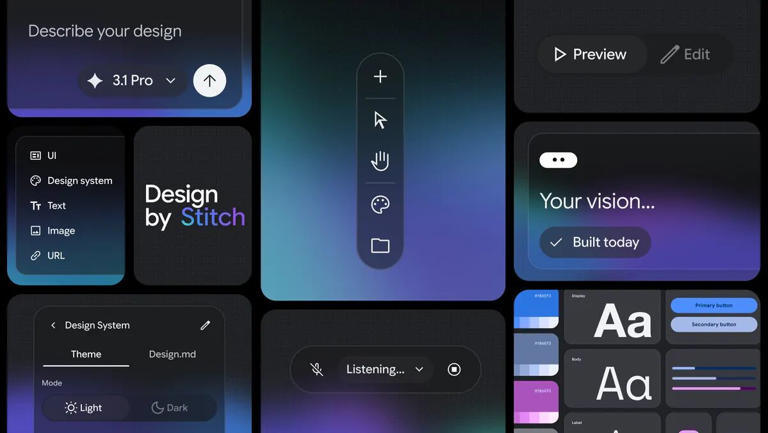
In March 2026, Google Labs officially upgraded its design tool Stitch into an AI-native design platform, making it a representative tool for Vibe Design in practice. This upgrade introduced several groundbreaking features:
- Voice Canvas: Users can speak directly to the canvas to make changes, with designs updating in real time based on voice commands—significantly shortening the time from idea to visible result.
- DESIGN.md Format: A new type of design rule–sharing document that allows AI-generated elements—such as color codes, typography, and spacing—to be managed like code and shared across tools, ensuring consistency within design systems.
- AI Design Agents: AI is no longer limited to single-point creation—it can understand the context of an entire project and explore multiple design directions simultaneously, allowing users to compare different versions in a very short time.
- Interactive Prototype Generation: With Stitch, static designs can be transformed into clickable, interactive prototypes with a single click, enabling immediate user testing.
📌 Why Is This Transformation So Important?
The rise of Vibe Design is not just a technological advancement—it represents the democratization of design. It significantly lowers the barrier to entry, allowing entrepreneurs without a design background to quickly bring product prototypes to life. At the same time, it enables rapid iteration: what once took a week to develop can now be expanded and refined into dozens of versions within a single afternoon of conversation.
However, despite the significant efficiency gains brought by AI-driven design, the trend in 2026 still emphasizes that Vibe Design is best suited for rapid prototyping and idea exploration. For highly precise adjustments and complex logic, the refined judgment of professional designers—combined with traditional tools—remains essential as the final step in delivering high-quality products.
As Google Stitch opens up MCP and SDK integrations, the workflow from design to development is being reshaped. In this "vibe"-driven competition, a designer's edge will no longer lie in how fast they operate software, but in their ability to define aesthetics and deeply understand human nature.
—
The content is organized from online sources.
#VibeDesign #AIGeneration #NaturalLanguage #LargeLanguageModels