
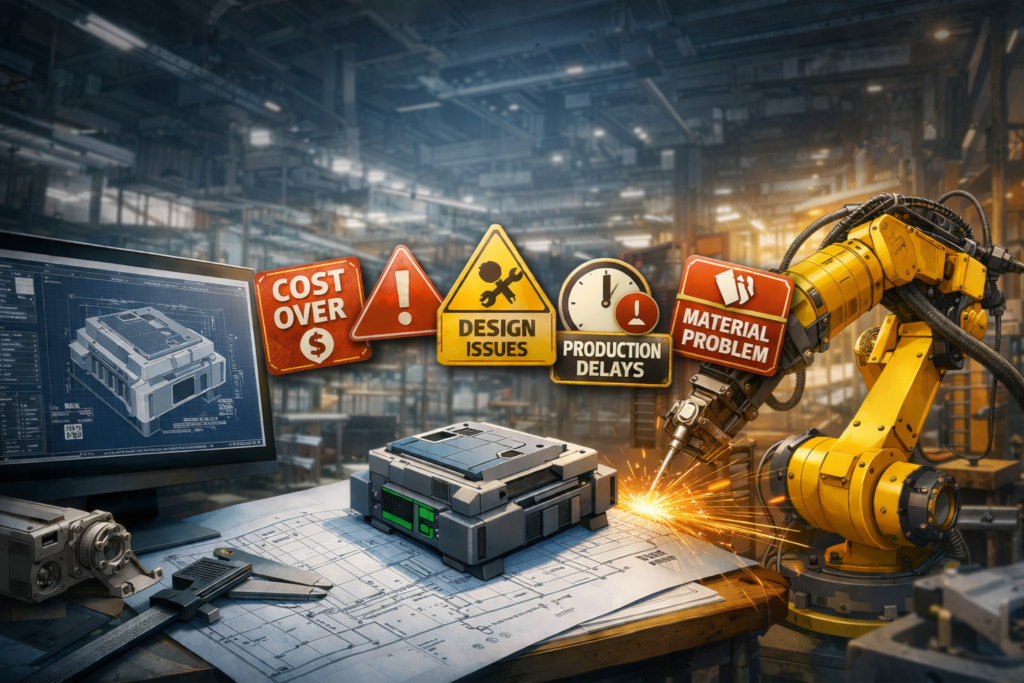
Many brands encounter a particularly frustrating situation during product development:
"The design looks great, but once it reaches the prototyping or mass production stage, problems start piling up."
The appearance may have passed internal reviews and even received positive market feedback, yet in the end it gets stuck because it can’t be made—or the costs spiral completely out of control.
👉 This is usually not because the design isn’t good enough, but because the realities of mass production were overlooked during the design stage.
Problem 1 | The design is created purely to "look good", not to "be manufacturable"
In the early stages, many designs have only one goal: to look good and be memorable.
But designs intended for mass production also need to consider:
- Whether the structure can be reproduced consistently.
- Whether it can be assembled efficiently.
- Whether each detail will significantly drive up costs.
👉 If a design is created solely for visual appeal, the cost will inevitably be paid later during manufacturing.
Problem 2 | The design is created without assuming a manufacturing process first
Different manufacturing processes have very different tolerances for design.
- Injection molding has strict requirements for wall thickness and draft angles.
- CNC machining is sensitive to structure and tool paths.
- Ceramics have very high limitations on shape and shrinkage rates.
👉 If the manufacturing process isn't defined during the design stage, factories can only make fixes after the fact.
Problem 3 | The structure works on paper, but not in reality
In CAD, the structure looks perfect and the dimensions are precise. But in mass production, reality includes variations, tolerances, and material deformation.
👉 If a design doesn't leave room for these "imperfect realities," mass production can quickly turn into a disaster.
Problem 4 | Material selection ignores supply chain realities
The materials chosen during the design stage aren't always the same materials that are actually available at the time of mass production.
Common situations include:
- Minimum order quantities are too high.
- Color or surface finishes are inconsistent.
- Long-term supply carries risks.
👉 If these issues are discovered too late, a redesign is almost inevitable.
Problem 5 | There is no "intermediate review" between design and manufacturing
Many teams follow a process like this: design completed → handed directly to the factory.
But in reality, there should be an intermediate step in between:
- A review of design rationality.
- A discussion of manufacturing feasibility.
- An evaluation of cost and production processes.
👉 Without this step, problems are guaranteed to surface later.
Problem 6 | Asking "Is this product worth making?" too late
This is the most critical point.
Once the design is finished and time and money have already been invested, the room for decision-making when discussing market fit and costs becomes very limited. If, early in the design stage, design can be used to help answer:
- Whether it can be made.
- Whether it's worth making.
- Whether it should be continued.
Product development becomes much safer.
Conclusion | Design for manufacturability is what allows a design to actually survive
A good-looking design doesn't necessarily mean there's a problem.
The real issue is that if a design isn't created with mass production in mind, it's very hard for it to survive in the market.
The value of design for manufacturability is not about limiting creativity,
but about giving creativity a real chance to be made—and to be sold.
—
The content is organized from online sources.
#productdevelopment #productdesign #developmentrisk #designprocess #designformanufacturing